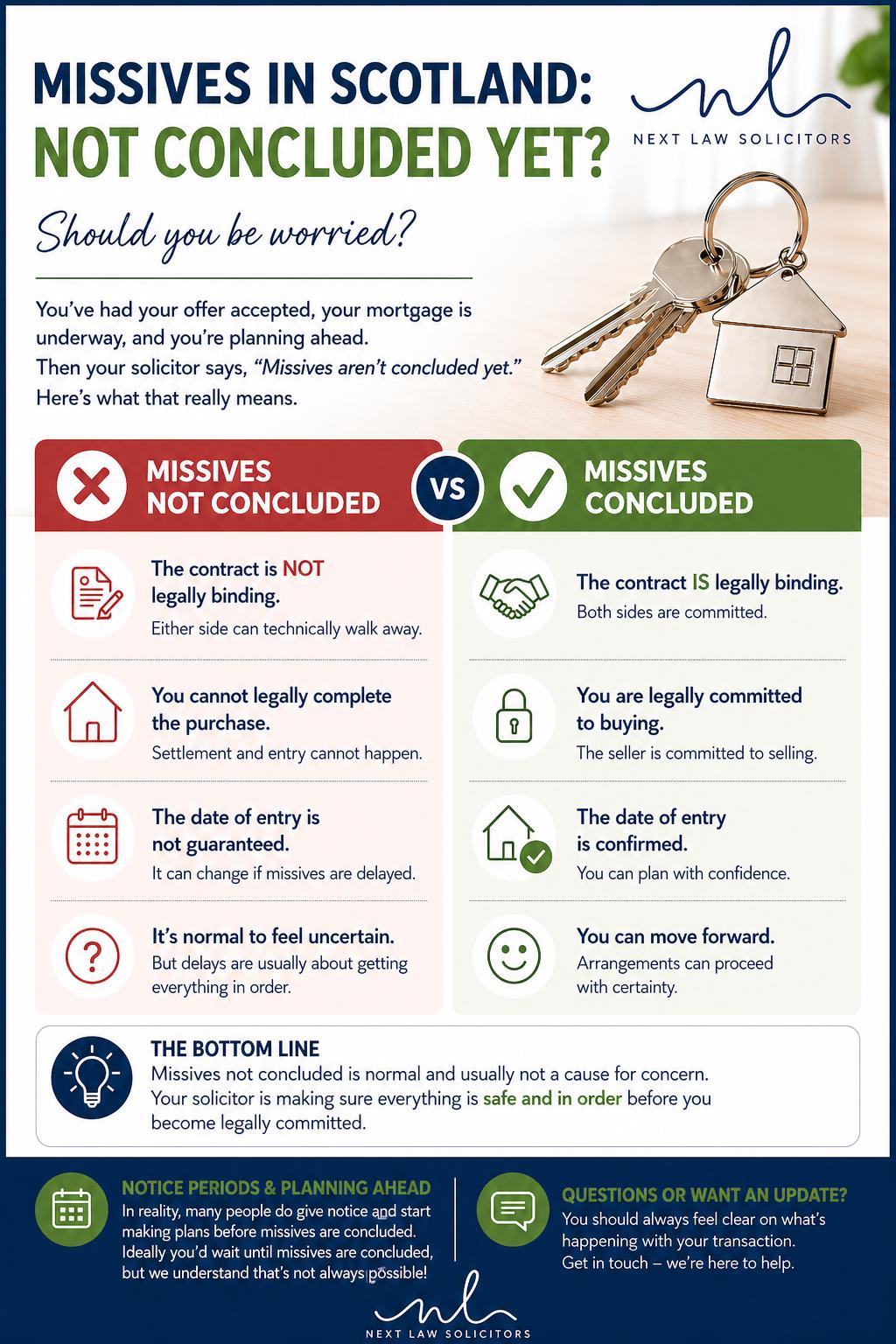
If you are buying or selling a home in Scotland and your solicitor has told you that missives are “not yet concluded”, it is natural to feel uneasy. Most people only buy or sell property a handful of times in their life, and the language of Scottish conveyancing can feel unfamiliar, particularly if you are moving from elsewhere in the UK. The short answer is this: in most cases, missives not being concluded is part of the normal process, rather than a sign that something has gone wrong. In fact, where there is a related sale or purchase, or a wider chain of properties, it is quite common for missives not to conclude until much closer to the date of entry.
This guide, written for clients across Perth, Perthshire and the wider area, explains what missives are, what it means when they are not yet concluded, why that might be, and when it is sensible to pick up the phone to your solicitor.
What missives actually are in Scotland
In Scotland, the contract to buy or sell a property is not a single document. It is made up of formal letters between your solicitor and the other side’s solicitor. These letters are called missives.
The buyer’s solicitor sends a written offer. The seller’s solicitor responds, often with a “qualified acceptance”, which means they are prepared to accept the offer but with adjustments or conditions. The two solicitors then go back and forth, agreeing the terms in writing. Sometimes this only takes one or two exchanges; in other cases there may be several rounds of missives before everything is agreed.
When both sides have agreed every point and the agreement is properly recorded in writing, the missives are described as “concluded”. From that point, there is generally a binding contract in place.
What “concluded missives” means
Concluded missives play a similar role in Scotland to exchange of contracts in England, although the process and the timing are different.
Before missives are concluded:
- The contract is still being put together.
- The position is different from the position after missives conclude, and the deal is not yet locked in.
- Your solicitor is working through checks and conditions on your behalf.
Once missives are concluded:
- A binding contract is generally in place between buyer and seller.
- The agreed date of entry is contractually fixed, unless both sides later agree to vary it.
- Stepping away from the transaction at that stage can have significant financial and legal implications.
So when your solicitor says missives are not yet concluded, what they mean is that the contract is still being put together. The work is happening behind the scenes; the final agreement is just not in place yet.
Why missives may not have concluded yet
There are many reasons why missives can take time to conclude. Some are technical, some are practical, and most are routine.
Title and property checks
Your solicitor needs to be confident that the seller actually owns what they are selling, and that there is nothing on the title that would cause problems for you later. If the title turns up something that needs further consideration, for example a right of access benefiting a neighbour, an existing burden, or a missing document, your solicitor will want this looked at properly before letting you commit.
Mortgage and finance conditions
If you are buying with a mortgage, your solicitor will usually want your formal mortgage offer in hand before concluding missives. Lenders sometimes ask for further information from valuers, surveyors, or the buyer themselves, and this can take a little time. It is rarely a problem; it is simply prudent.
Linked transactions and property chains
In many residential transactions, missives do not conclude until much nearer the agreed date of entry. This is particularly common where there is a related sale and purchase, or where several transactions are linked together in a chain. For example, a buyer may be relying on the sale of their current home, or a seller may be relying on the purchase of their next property. In those situations, solicitors will often wait until the related transactions are also ready before concluding missives, so that clients are not contractually committed to one transaction before the connected transaction is sufficiently secure.
Special conditions and clauses being negotiated
Most Scottish residential offers are based on the Scottish Standard Clauses, with adjustments or special conditions added where required. You might have asked for repairs to be carried out, for items of furniture to be included, or for a particular date of entry. The seller might have asked for something in return. Each addition needs to be agreed in writing.
External factors
Sometimes the position sits outside your transaction altogether. A factor or a local authority may be working through a query. An executor selling a deceased relative’s home may be waiting on Confirmation, which is the Scottish process giving an executor authority to deal with a deceased person’s estate. None of these are necessarily signs that your purchase is in trouble.
Should you be worried?
In most cases, no. A period between offer and concluded missives is normal and expected. Solicitors do not conclude missives until they are satisfied that the relevant checks have been carried out, and that means asking the right questions and resolving any queries before signing you up to a binding contract.
That said, it is reasonable to want clarity. If a significant amount of time has passed and you have not had an update, it is perfectly sensible to ask your solicitor where things stand and what is outstanding.
Verbal agreement, accepted offer and concluded missives: the difference
This is one of the most common areas of confusion, particularly for buyers moving from England.
A verbal agreement
If an estate agent tells you over the phone that the seller is happy with your offer, that is encouraging, but it does not put a contract in place. Either party can change their position.
An accepted offer
When your solicitor’s formal written offer is met with a written response from the seller’s solicitor, things have moved on. There is now a paper trail. However, if that response is a qualified acceptance, which it often is, the contract is not yet complete. Conditions still need to be agreed.
Concluded missives
This is the point at which the deal becomes binding. Both sides have agreed everything in writing, the final letter has been sent, and the contract is now in place.
Until you reach concluded missives, the safest assumption is that the deal is progressing but not yet locked in.
What you should and should not do while waiting
A few practical points that often help avoid unnecessary stress:
- Avoid giving notice on a rented home until missives are concluded.
- Avoid booking removals on a non-refundable basis, or paying deposits, until missives are concluded. Provisional enquiries are, of course, sensible.
- Avoid committing to school places, new utility contracts or major purchases tied to the new address until your solicitor confirms the contract is in place.
- Keep your solicitor up to date with anything that changes for you, particularly anything affecting your finances or your preferred timescale.
- Respond promptly when your solicitor asks for documents or information. Delays often come down to paperwork sitting with a buyer or seller, rather than with the solicitors themselves.
When to ask your solicitor for an update
A short pause between accepted offer and concluded missives is normal. If you are not sure whether the pause is reasonable, a quick call or email to your solicitor is always appropriate. Sensible moments to check in include:
- You have not heard anything for a couple of weeks since your offer was accepted in principle.
- Your circumstances have changed, for example a new job, a change of mortgage product, or a change of timescale.
- You have been told a date of entry verbally and want to know whether it is now fixed.
- You are about to make a financial commitment that depends on the contract being in place.
Your solicitor should be happy to explain what stage matters have reached. It is far better to have a brief, clear conversation than to sit and worry.
Speaking to our team in Perth
Buying or selling a home in Scotland is a significant step, and we know the process feels easier when it is explained calmly and in plain language. Our conveyancing team at Next Law acts for clients across Perth, Perthshire and the wider area, and we are happy to talk you through any stage of the process.
If you are buying or selling in Perth, Perthshire or further afield in Scotland, our team would be happy to guide you through the process clearly and calmly. Speak to our conveyancing team if you are planning a move, or, if you are already a Next Law client, please contact us and we will be happy to explain the next steps in your transaction.
This is general information only and does not constitute legal advice.
Frequently asked questions
Are missives the same as exchange of contracts in England?
They play a similar role. Both mark the point at which a property contract is generally treated as binding. The mechanics, timing and language are different, however, and Scottish conveyancing has its own process. If you are moving from England, expect things to feel different rather than simply faster or slower.
Can the seller still change their position before missives are concluded?
Generally, yes. Until missives are concluded, the contract is not yet in place. This is one reason your solicitor will not delay unnecessarily, but also why they will not rush past important checks. If you have a specific concern about a particular transaction, your solicitor can talk you through how it applies in your case.
How long do missives usually take to conclude?
There is no fixed answer. Some transactions conclude quickly, others take longer because of mortgage offers, title queries, chains or linked transactions. Your solicitor can give you a realistic indication based on what is outstanding in your particular case.
What is a qualified acceptance?
A qualified acceptance is a written response from the seller’s solicitor that responds to your offer subject to certain conditions or amendments. It is part of the normal back-and-forth that leads to concluded missives.
Should I be worried if my offer was accepted but missives are not concluded?
Not usually. An accepted offer is a strong signal that both sides want the deal to happen, but it is not yet a binding contract. Until missives are concluded, your solicitor is still working through the detail.
Can I move into the property before missives are concluded?
In normal residential conveyancing, no. Entry is dealt with under the contract, and you should not plan to move into the property until your solicitor has confirmed that missives are concluded and the date of entry is agreed in writing.
What happens once missives are concluded?
Your solicitor will progress to the disposition, which is the document that actually transfers ownership, final mortgage arrangements, funds, and the practical steps around the date of entry. From this point, the focus shifts to settling the transaction.