If you are moving from England to Scotland and have started to look at properties, you may notice fairly quickly that buying a house here feels different. It is not harder, simply structured differently. Once you understand the shape of it, the Scottish process is usually clearer than it first appears.
This guide, written for clients moving to Perth, Perthshire and the wider area, walks through how buying a home in Scotland actually works, from your first offer through to picking up the keys. It is intended for people heading north for the first time, or returning after a long time away.
A different system, not a harder one
The main milestones in a Scottish house purchase are:
- You make a formal written offer through a solicitor.
- Your solicitor and the seller’s solicitor negotiate the missives, which are the contract letters.
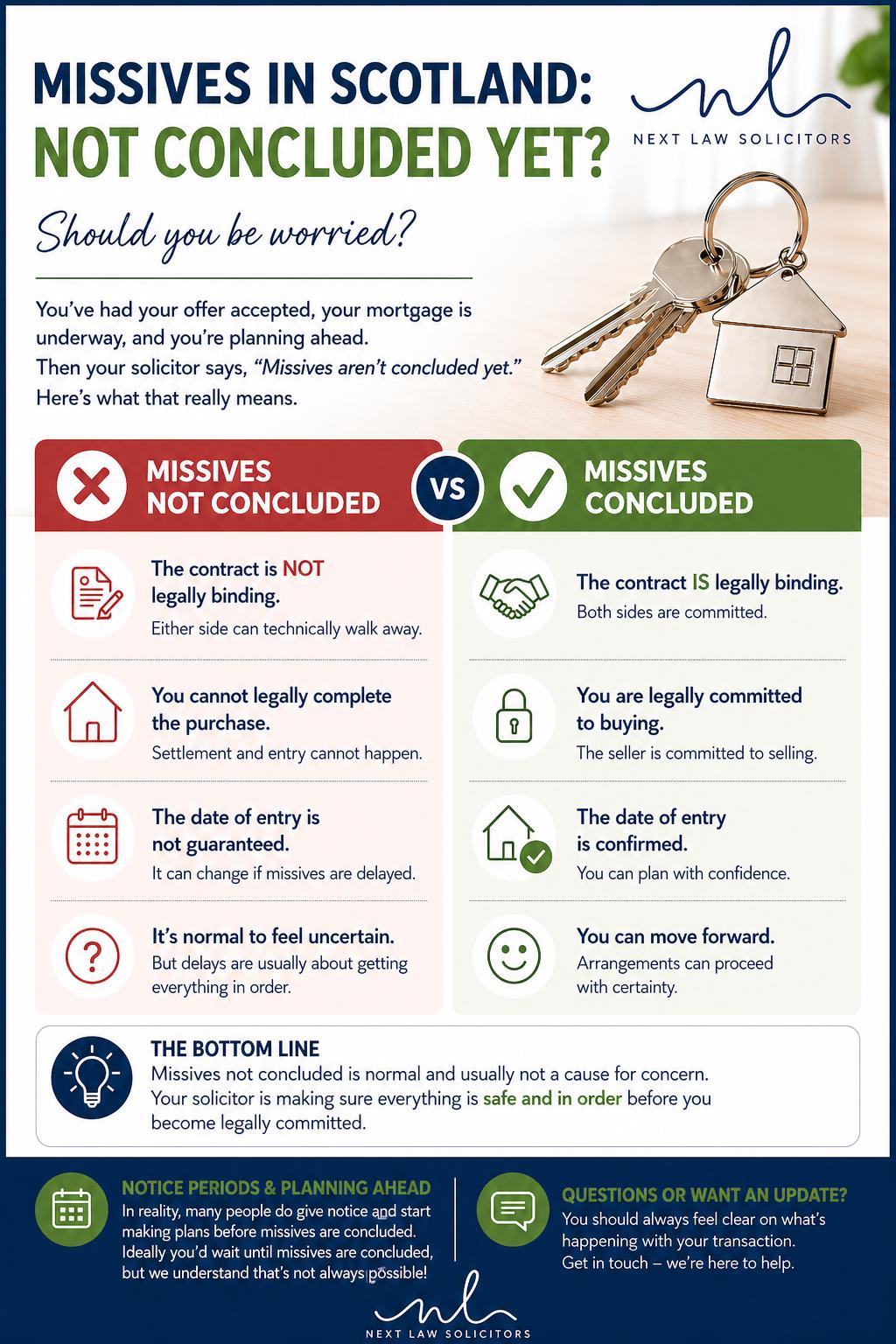
- Missives are concluded, at which point the contract is generally treated as binding.
- The date of entry arrives, funds change hands, and you take possession.
- Your solicitor registers your title with Registers of Scotland.
You will not exchange contracts in the English sense, and you will not pay Stamp Duty. The equivalents exist; they simply have different names and slightly different mechanics.
How offers work in Scotland
Offers go through your solicitor
In Scotland, your formal offer is submitted in writing by your solicitor, on your behalf, to the seller’s solicitor. This is one of the most important practical differences from the English process, where price is often agreed verbally with the estate agent before solicitors are formally instructed.
Until your solicitor sends a written offer, nothing has been formally offered to the seller. The selling agent will pass on your interest, but the legal process starts with the offer letter. Before that stage, your solicitor can formally note your interest with the selling agent, which is often what prompts the agent to let you know if a closing date is set.
“Offers over” and closing dates
Many properties in Scotland are marketed as “offers over” a figure, particularly in popular areas. If more than one party is interested, the selling agent may set a closing date. At that point, each interested party submits a single sealed written offer through their solicitor by the deadline.
The seller is not obliged to accept the highest offer, or any offer. Price matters, but conditions, the date of entry, your finance position and any related sale or chain can all play a part. Your solicitor will help you put forward an offer that is realistic and properly structured.
The Home Report
In Scotland, the seller provides a Home Report before the property is marketed. This generally includes:
- A single survey, which includes a valuation of the property.
- An energy report.
- A property questionnaire completed by the seller.
For buyers used to commissioning their own survey in England, this can feel unfamiliar. The Home Report does much of that work upfront. Most lenders will work from the Home Report valuation, although they may instruct a separate valuation of their own. If you have particular concerns about a specific property, you can still commission a more detailed specialist report on top.
Missives, not exchange of contracts
The contract for a Scottish house purchase is not a single document signed by both parties. It is built up through a series of formal letters between the two solicitors. Those letters are called missives.
What missives are
Your solicitor’s offer is the starting point, usually based on the Scottish Standard Clauses with adjustments or special conditions added where required. The seller’s solicitor will typically respond with a “qualified acceptance”, agreeing to your offer subject to adjustments or conditions. The two solicitors then go back and forth until every point has been agreed in writing.
Concluded missives compared with exchange of contracts
When the missives are concluded, the contract is generally treated as binding. This is broadly the Scottish equivalent of exchange of contracts in England, although the timing and mechanics are different. One practical difference is that you will not usually pay a deposit when missives are concluded, as you might on exchange in England; the price is generally payable in full at the date of entry. We cover this in more detail in a separate guide on missives.
Linked transactions and property chains
If you are buying in Scotland while selling in England, you have a cross-border chain. That is perfectly normal, but it does mean two systems are running alongside each other, each with its own pace. Your Scottish solicitor and your English solicitor will need to communicate, particularly around timing.
In linked transactions, missives in Scotland often do not conclude until much nearer the agreed date of entry. This is so that you are not contractually committed to your Scottish purchase before the English sale is sufficiently secure. Your solicitor will explain how this applies to your particular position.
Surveys, searches and conveyancing checks
While the Home Report covers much of the property’s condition, your solicitor will still carry out a series of conveyancing checks. These include searches against the title with Registers of Scotland, searches against you as a party, and enquiries with the local authority. The structure and names differ from the English equivalents, but the purpose is similar: making sure there are no surprises before you commit. Before the date of entry, your solicitor will report to you on the title, so that you understand exactly what you are buying before any funds change hands.
Mortgages and finance
If you already have a mortgage in principle from a UK lender, that will usually carry across. Most major lenders offer mortgages on both sides of the border and are familiar with the Scottish form of security, which is broadly the equivalent of an English mortgage charge. Your solicitor will work directly with your lender once a formal offer is in place.
It is worth telling your broker or lender early on that you are buying in Scotland, simply so they can route the application correctly from the start.
LBTT instead of Stamp Duty
In Scotland, the tax on property purchases is Land and Buildings Transaction Tax (LBTT), not Stamp Duty Land Tax. LBTT is administered by Revenue Scotland. The rates, bands and reliefs are different from SDLT, and can change over time.
There is also an Additional Dwelling Supplement (ADS), which can apply if, on the date of entry, you own more than one residential property anywhere in the world. If you are moving from England and still own your previous home on the date of entry in Scotland, ADS may apply to the Scottish purchase. In certain circumstances, ADS can be reclaimed once your previous main residence is sold within the prescribed period. Because ADS is calculated on the purchase price and is paid up front, it can add a substantial amount to the cost of your move. Where it applies, you would fund it at the date of entry and, if the reclaim conditions are met, recover it only once your previous home has sold. This is one reason the timing of a linked sale and purchase matters, as covered above. The detail matters here, and your solicitor will go through how it applies in your specific case well in advance of the date of entry.
We cover the full cost picture, including LBTT and outlays, in a separate guide.
The date of entry
The “date of entry” is the day you take possession of the property. It plays a similar role to completion in England. There is usually no separate exchange and completion in a Scottish transaction: the contract becomes binding when missives are concluded, and the date of entry is contractually fixed at that point, unless both sides later agree to vary it.
On the date of entry, your solicitor receives your mortgage funds and your contribution, transfers the price to the seller’s solicitor, receives the signed disposition (the deed that transfers ownership to you), and the keys are released. From that point, the property is yours to occupy. If you have a related English sale, your two solicitors will coordinate so that funds and timings line up across the chain.
After the keys: registration and final steps
Once you have moved in, your solicitor will:
- Pay LBTT (and any ADS) to Revenue Scotland.
- Register your title with Registers of Scotland.
- Register your lender’s standard security, which is the Scottish equivalent of a mortgage charge.
- Confirm once your title has been registered with Registers of Scotland, and send you a copy of your registered title for your records.
Registration completes the legal picture and confirms you as the registered owner. The work continues quietly behind the scenes for a short period after you have the keys.
Practical things to plan before you move
A few things worth thinking about early:
- Tell your bank, employer, HMRC and any subscriptions about your change of address in good time.
- Set up your council tax with the relevant Scottish local authority. Council tax bands and rates are set differently in Scotland.
- Register with a Scottish GP and, if relevant, look into school admissions, which run on different rules and term dates in Scotland.
- Plan your removals carefully around the date of entry. Provisional enquiries are sensible at any stage, but avoid, where possible, booking on a non-refundable basis, or paying deposits, until missives are concluded.
- Make sure your buildings insurance is in place from the date of entry.
Speaking to our team in Perth
Moving from England to Scotland is a significant step, and we know it helps to have a solicitor who explains each stage in plain language as you go. Our conveyancing team at Next Law acts for clients moving to Perth, Perthshire and the wider area, and we are used to walking buyers through the Scottish process for the first time.
If you are buying or selling in Perth, Perthshire or further afield in Scotland, our team would be happy to guide you through the process clearly and calmly. Speak to our conveyancing team if you are planning a move, or, if you are already a Next Law client, please contact us and we will be happy to explain the next steps in your transaction.
This is general information only and does not constitute legal advice.
Frequently asked questions
Do I need a Scottish solicitor to buy a house in Scotland?
Property law in Scotland is different from the law in England and Wales, and the conveyancing process involves Scottish forms, searches and registrations. A Scottish-qualified solicitor is the appropriate route for a Scottish purchase.
Can my English solicitor handle the Scottish side of the transaction?
Solicitors qualified only in England and Wales generally do not handle Scottish conveyancing. If your usual solicitor is based south of the border, it is common to instruct a Scottish firm for the Scottish purchase while keeping your English solicitor for the sale of your existing home.
What is a Home Report and do I still need my own survey?
A Home Report is provided by the seller and generally includes a single survey (including valuation), an energy report and a property questionnaire. Most buyers rely on it as their main survey. If you have specific concerns about a particular property, you can still commission a more detailed specialist report on top.
How is LBTT different from Stamp Duty?
LBTT is the Scottish equivalent of Stamp Duty Land Tax and is administered by Revenue Scotland. The rates, bands and reliefs are different from the English system, and figures can change from time to time. Your solicitor will calculate the figure for your specific purchase.
What happens if I still own my English house when I buy in Scotland?
If you still own your previous home on the date of entry, the Additional Dwelling Supplement (ADS) may apply to your Scottish purchase. In certain circumstances, ADS can be reclaimed once your previous main residence is sold within the prescribed period. Your solicitor will explain how this applies in your particular case.
Do I exchange contracts in Scotland?
No. The Scottish equivalent is the conclusion of missives, which is the point at which the contract is generally treated as binding. The process is built around formal letters between solicitors rather than a single signed document.
How long does the process usually take?
There is no fixed answer. Much depends on your finance, the seller’s position, any chain or linked transaction, and the property itself. Your solicitor can give you a realistic indication once they understand the specifics of your purchase.