When people start working out whether they can afford a house in Scotland, the conversation usually begins with the asking price and the deposit. That is the right starting point, but it is rarely the full picture.
There are a number of other costs to take into account, and in Scotland there is another particularly important consideration: the price you agree to pay may be higher than the Home Report valuation, with the difference potentially having to come from your own funds.
This guide, written for clients buying in Perth, Perthshire and the wider area, sets out the main costs involved in buying a house in Scotland. It explains what each cost is for, how it tends to arise and where to look for current figures.
We have deliberately avoided quoting specific tax rates, thresholds or registration dues, as these can change from time to time. Your solicitor will provide the up-to-date figures applicable to your particular purchase.
What does the cost of buying actually include?
Aside from the purchase price itself, a typical Scottish house purchase may involve:
- Your deposit and, where applicable, any amount you are paying above the Home Report or lender’s valuation.
- Land and Buildings Transaction Tax (LBTT), and possibly the Additional Dwelling Supplement (ADS).
- Your solicitor’s professional fee.
- Outlays and registration costs associated with the legal work.
- Mortgage-related costs charged by your lender or broker.
- Practical costs around the move itself, including removals, insurance and setting up your new home.
Most of these costs can be identified reasonably early once you know the purchase price, your mortgage arrangements and the circumstances of the transaction. Your solicitor’s written quote should explain the legal fees and anticipated outlays before you proceed.
Paying more than the Home Report valuation
This is one of the most important points for buyers in Scotland to understand.
The asking price shown in the property particulars is not necessarily the same as the Home Report valuation, and in a competitive market a buyer may decide to offer more than the valuation in order to secure a property.
Mortgage lending will generally be based on the value accepted by the lender, which in many Scottish purchases will be based on the Home Report valuation. If you agree to pay more than that valuation, you may therefore require to fund the difference from your own funds, in addition to your normal deposit and the other costs of buying.
Before deciding how much to offer, it is sensible to understand both the Home Report valuation and how much you will require from your own funds to complete the purchase.
Land and Buildings Transaction Tax (LBTT)
LBTT is the property transaction tax which applies to purchases of land and buildings in Scotland.
How LBTT is calculated
For residential purchases, LBTT is calculated in bands, with different rates applying to different portions of the purchase price.
The rates, bands and thresholds are set by the Scottish Government and can change from time to time. Revenue Scotland publishes an online LBTT calculator, which is a useful way of checking the current tax position for a particular purchase price.
Your solicitor will calculate the LBTT due on your purchase, prepare and submit the necessary return to Revenue Scotland and normally arrange payment of the tax on your behalf.
First-time buyer relief
First-time buyer relief is available in Scotland in certain circumstances and can reduce the amount of LBTT payable on a qualifying purchase.
There are conditions which must be satisfied, including requirements relating to previous property ownership and occupation of the property as the buyer’s only or main residence.
Your solicitor will consider whether the relief is available to you when calculating the LBTT payable on your purchase. Revenue Scotland publishes the current rules and limits on its website.
Additional Dwelling Supplement (ADS)
ADS is an additional amount of LBTT which can apply when the purchase results in a buyer owning more than one residential property.
Broadly, ADS may apply if, at the end of the effective date of the purchase, you will own two or more residential properties and you are not replacing your only or main residence. Property owned elsewhere in the world can be relevant.
The rules require particular care where:
- You are buying your new home before selling your existing main residence.
- The property will be a second home or buy-to-let.
- You are buying jointly and one of the buyers already owns another residential property.
- You own, or have an interest in, another residential property.
There are important exceptions and reliefs, particularly where a buyer is replacing an only or main residence.
In certain circumstances, ADS paid on the purchase of a new main residence can also be reclaimed if the previous main residence is subsequently sold within the period prescribed by the legislation.
ADS can be a significant additional cost, so it is important that you tell your solicitor about any other residential property owned by you, or by anyone purchasing jointly with you, at an early stage.
Your solicitor can then advise how the rules apply to your particular circumstances.
Solicitor’s fees
Your solicitor’s professional fee covers the legal work involved in taking you from your initial offer through to settlement and registered ownership.
Depending on the transaction, that work will normally include preparing and submitting your offer, negotiating and concluding the missives, examining the title and conveyancing documentation, dealing with your mortgage lender, completing the transaction on the date of settlement and registering your ownership afterwards.
Fees vary depending on the nature and complexity of the transaction and any unusual work which may be required.
Most Scottish solicitors will provide a written quote at the outset, explaining their professional fee and the anticipated outlays. The quote should also make clear what work is included and whether there are circumstances in which additional fees might arise.
Outlays: third-party costs associated with your purchase
Outlays are payments to third parties arising in connection with the legal work. They are separate from your solicitor’s professional fee and will normally be itemised separately in your quote and final statement.
It is worth noting that not every search or report seen during a purchase is necessarily an outlay payable by the buyer.
In a typical residential transaction using the Scottish Standard Clauses, the seller is responsible for providing certain searches and reports required for settlement, including the Legal Report and Property Enquiry Certificate.
Your solicitor will examine these as part of the purchase and may require additional searches or reports depending on the property, the title, your lender’s requirements or the particular circumstances of the transaction.
Some of the main purchaser’s outlays can include the following.
Registration dues
After settlement, your solicitor will apply to Registers of Scotland to register your ownership of the property.
The registration fee for the Disposition transferring ownership is based on the consideration or value of the property, whichever is greater.
If you are buying with a mortgage, your lender will normally also require a Standard Security to be registered against the property. A separate registration fee applies to that deed.
Current registration dues are published by Registers of Scotland and your solicitor will include the appropriate amounts in your purchase statement.
Advance Notices
Advance Notices provide important protection during the period between settlement of the transaction and registration of the relevant deeds in the Land Register.
In a standard residential purchase, the Advance Notice protecting the Disposition in your favour will normally be dealt with by the seller’s side.
If you are purchasing with a mortgage, a separate Advance Notice may also be required for the Standard Security which you grant in favour of your lender. The cost of an Advance Notice relating to a deed granted by you may therefore form part of your purchase outlays.
Bank transfer charges
Settlement of a property purchase will normally involve an electronic transfer of the purchase funds.
The bank may make a charge to your solicitor for transferring those funds, and your solicitor may pass that charge on to you as an outlay. Any such charge should be identified in your solicitor’s quote or purchase statement.
Mortgage-related costs
If you are buying with a mortgage, there may be additional costs to factor into your budget. These will depend upon your lender and the mortgage product you select, but can include:
- An arrangement or product fee charged by the lender, which may be paid upfront or added to the mortgage.
- A valuation fee if the lender requires a separate valuation or cannot rely upon the existing Home Report valuation.
- A broker fee if you are using a mortgage broker.
Your lender should set out its charges in the mortgage documentation and your broker should explain any fee which they charge.
Other practical costs to plan for
The legal, tax and mortgage costs are only part of the overall cost of moving home. There are several other expenses worth considering at an early stage.
Removals
Removal costs will depend on how much you are moving, the distance involved, the services you require and the time of year.
It is sensible to obtain quotes and consider availability reasonably early in the process.
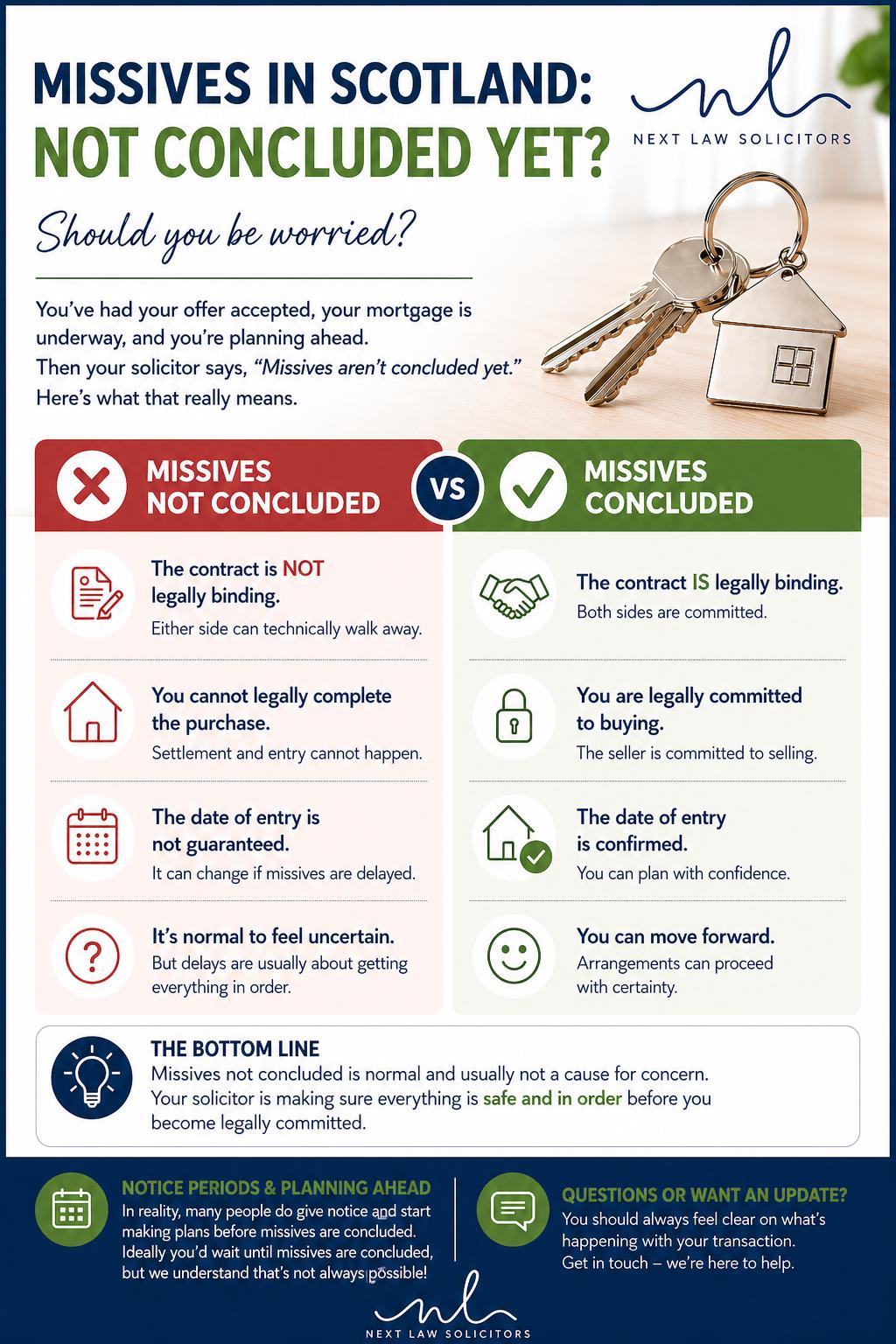
Ideally, buyers should avoid making significant non-refundable commitments before missives are concluded and the date of entry is contractually fixed. In practice, however, missives can sometimes be concluded quite close to the date of entry and it may not always be practical to wait before making any arrangements.
If you do need to make a booking earlier, check the removal company’s cancellation and change-of-date terms carefully and, where possible, choose arrangements which give you some flexibility if the transaction does not proceed on the anticipated date.
Your solicitor can keep you informed about the progress of the missives so that you can make as informed a decision as possible.
Buildings insurance
The risk of damage to the property will normally remain with the seller until settlement.
You should therefore arrange for your buildings insurance to take effect from settlement, which will normally be your date of entry. If you are buying with a mortgage, your lender may also have particular insurance requirements.
Council tax and utilities
You should notify the relevant local authority that you have taken ownership and occupation of the property and arrange for council tax to be put into your name.
You should also arrange for the relevant utility providers to be notified when you take possession of the property and take appropriate meter readings where applicable.
Decorating, repairs and immediate expenditure
The Home Report may identify repairs, maintenance issues or other matters which you should take into account when deciding what you can afford.
You may also wish to budget for decorating, furnishings, replacement appliances or other expenditure shortly after moving in.
The Home Report is an important source of information, but buyers should consider its contents carefully and take further advice or obtain specialist reports where necessary.
A realistic way to budget
A useful way to think about the overall cost of a Scottish house purchase is to divide your available funds into four broad areas:
1. Purchase funding
Your deposit, together with any additional amount you require to pay from your own funds because the agreed purchase price exceeds the valuation accepted by your lender.
2. Tax
LBTT and, if applicable, ADS. Revenue Scotland’s calculator can help provide an indication once you know the purchase price and your circumstances.
3. Legal and registration costs
Your solicitor’s professional fee together with the registration dues and any other purchaser’s outlays applicable to your particular transaction.
4. Mortgage and moving costs
Lender or broker fees, removals, insurance and an allowance for the initial practical costs of moving into your new home.
Thinking about all four areas at the beginning can make the overall cost of the purchase much clearer and reduce the likelihood of an unexpected funding requirement shortly before settlement.
Speaking to our conveyancing team in Perth
Working out the overall cost of buying a house in Scotland is much easier when each part of the transaction is explained clearly from the outset.
Our conveyancing team at Next Law acts for clients buying and selling property throughout Perth, Perthshire and elsewhere in Scotland. We will explain the legal process, anticipated fees and outlays and the funds you are likely to require as your transaction progresses.
If you are considering buying or selling a property, contact our conveyancing team and we will be happy to provide a clear written quote and guide you through the process.
If you are already a Next Law client and have questions about the costs or funding required for your particular transaction, please contact us and we will be happy to assist.
This is general information only and does not constitute legal advice. The tax and legal position will depend on the circumstances of each individual transaction.
Frequently asked questions
How is LBTT different from Stamp Duty?
LBTT is the property transaction tax which applies in Scotland. Stamp Duty Land Tax applies to property transactions in England and Northern Ireland, while Wales has its own Land Transaction Tax.
The rates, bands and reliefs differ between the different tax regimes. Your solicitor will calculate the LBTT applicable to your particular Scottish purchase and submit the necessary return on your behalf.
Where can I check the LBTT for a particular purchase price?
Revenue Scotland publishes an online LBTT calculator which uses the current rates and bands.
Your solicitor will also calculate the amount payable as part of preparing for your purchase.
Do first-time buyers pay LBTT in Scotland?
First-time buyer relief is available in certain circumstances and can reduce the LBTT payable on a qualifying purchase.
The relief is subject to qualifying conditions and your solicitor can advise whether it applies to your particular purchase.
When does ADS apply?
ADS may apply where the purchase results in you owning two or more residential properties and you are not replacing your only or main residence.
The rules can also affect joint purchasers where only one buyer owns another property, and property situated outside Scotland can be relevant.
There are various exceptions and reliefs, so it is important to discuss your circumstances with your solicitor rather than assuming that ADS will or will not apply.
Can ADS be reclaimed?
In certain circumstances, yes.
If ADS has been paid because your previous main residence had not been sold when you bought your new main residence, it may be possible to reclaim the ADS if the previous property is sold within the prescribed period and the relevant statutory conditions are satisfied.
Your solicitor can explain the requirements applicable to your transaction.
What happens if I offer more than the Home Report valuation?
If your lender bases its lending on the Home Report valuation or another valuation which is lower than the price you have agreed to pay, you may need to fund the difference from your own funds.
That amount will be in addition to the deposit, LBTT, legal costs and other expenses associated with the purchase.
What is the difference between solicitor’s fees and outlays?
Your solicitor’s fee is the charge for carrying out the legal work involved in your purchase.
Outlays are separate third-party costs incurred in connection with the transaction, such as registration dues and, depending on the circumstances, Advance Notice or bank transfer charges.
Your written quote should distinguish between the professional fee and anticipated outlays.
Will my solicitor give me a written quote before I commit?
Most Scottish solicitors will provide a written quote setting out their professional fee and the anticipated outlays.
The quote should explain what work is included and highlight any circumstances in which additional work or costs could arise.
Should I wait until missives are concluded before booking removals?
Ideally, you should avoid significant non-refundable commitments until missives are concluded and your date of entry is contractually fixed.
However, missives can sometimes conclude quite close to the anticipated moving date, so waiting until then is not always practical.
If you need to book removals earlier, check the cancellation and change-of-date terms carefully and try to retain as much flexibility as possible.
Are there any costs buyers commonly overlook?
One of the most important is any amount being paid above the valuation accepted by the mortgage lender, as this may need to come entirely from the buyer’s own funds.
Other costs which can be overlooked include mortgage product or broker fees, registration costs, removals, buildings insurance and the initial cost of repairs, decorating, furnishings and setting up the new home.