The date of entry is the day you take possession of your new home. By the time it arrives, the bulk of the legal work has been done. What happens on the day itself is the careful handover of money, documents and keys between the two firms of solicitors, with you as the client at one end of it.
This guide, written for clients buying in Perth, Perthshire and the wider area, walks through what actually happens on the date of entry, step by step. It is intended for buyers who want to know how the day fits together so they can plan around it confidently.
What “date of entry” actually means
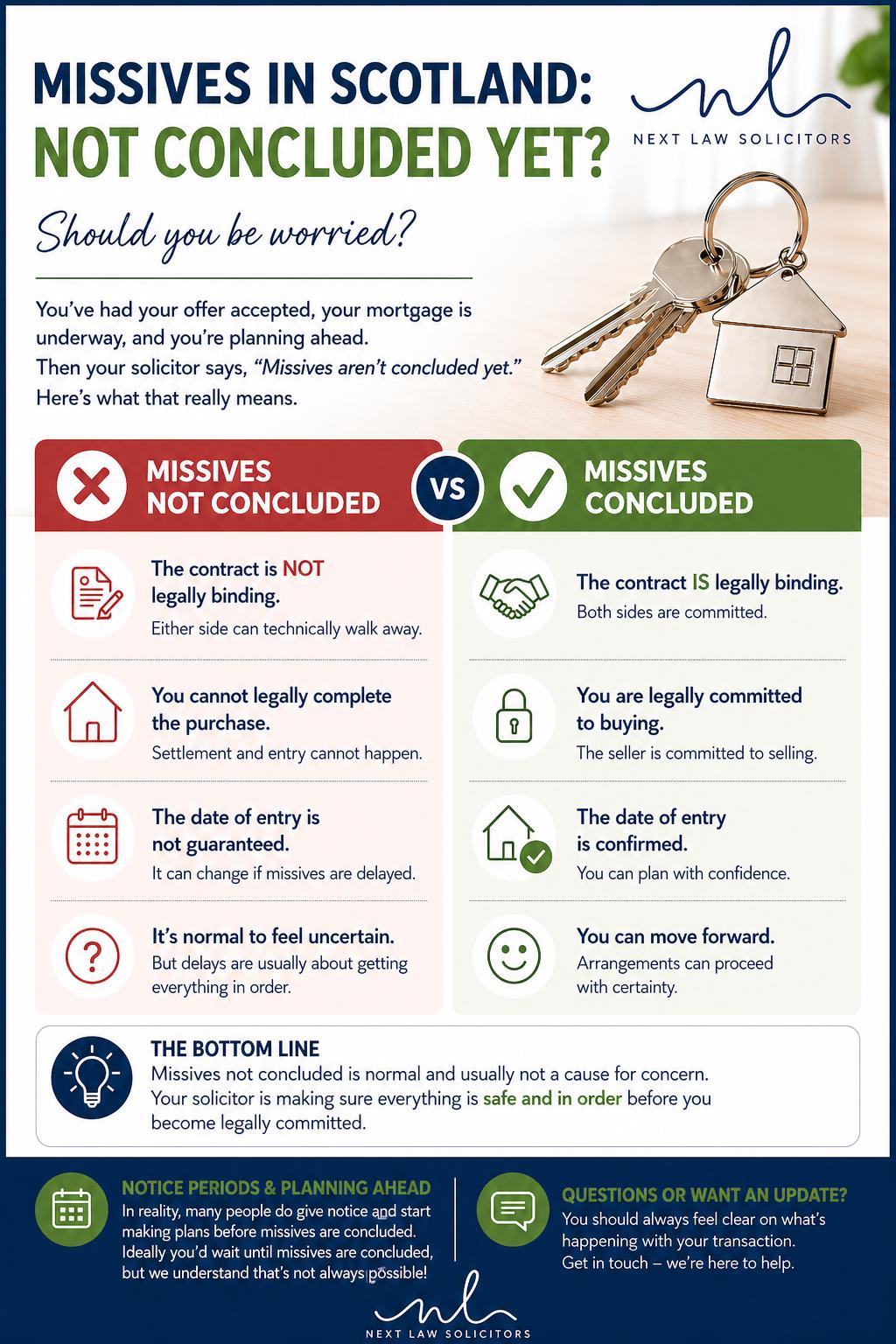
The date of entry is the day on which you become entitled to take possession of the property. It is fixed in the missives once they are concluded, and is contractually fixed at that point, unless both sides later agree to vary it. It is broadly the Scottish equivalent of completion in England.
On the date of entry:
- Your solicitor pays the purchase price to the seller’s solicitor.
- The seller’s solicitor delivers the signed disposition, the deed used to transfer ownership, and authorises release of the keys.
- Possession of the property passes to you.
Everything else on the day is the practical work that makes those three things happen safely and in the right order.
The week before the date of entry
Most of the moving parts are dealt with in the few working days before the date of entry so that the day itself can run smoothly.
Final figures and the statement of funds
Your solicitor will send you a statement of funds, sometimes called a settlement statement or cash account. It sets out the price, your mortgage advance if applicable, any LBTT and ADS, the solicitor’s fee, the outlays and the balance you need to put in. You will be told exactly how much to transfer, and by when.
The balance is usually requested a few working days in advance so it has cleared into the firm’s client account before the date of entry. Sending funds promptly helps avoid an unnecessary delay to settlement.
Signing the disposition
The disposition is the legal deed used to transfer ownership of the property from the seller to you. The seller signs it and it is delivered to your solicitor at settlement. Your solicitor then submits it to Registers of Scotland for registration.
As purchaser, you do not sign the disposition. If you are buying with a mortgage, you will normally sign a separate standard security in advance of the date of entry.
Mortgage funds drawdown
If you are buying with a mortgage, your solicitor will request the funds from your lender in time to be on the firm’s client account on, or just before, the date of entry. Different lenders work to different timescales and your solicitor will time the request to suit.
Advance Notice
Shortly before the date of entry, the seller’s solicitor will usually lodge an Advance Notice at Registers of Scotland. This is a legal step which protects your position in the period between settlement and registration of your title.
Final practical checks
In the same window, your solicitor will:
- Confirm the figure that needs to be transferred to the seller’s solicitor.
- Check updated legal reports and searches to ensure there are no entries affecting the seller’s title or the transaction.
- Coordinate with the seller’s solicitor on timing.
- Confirm arrangements for releasing the keys, often via the selling agent.
The morning of the date of entry
On the day, your solicitor’s focus is on getting funds across and keys released as soon as practically possible. It is normal for this to take a few hours rather than to happen at any particular fixed time.
If your purchase is linked to your sale, or forms part of a wider chain, settlement may take longer because funds may need to move through earlier transactions before your purchase can settle.
Final exchanges between solicitors
The two solicitors confirm that everything required for settlement is in place, including the signed disposition, updated legal reports and searches, the Advance Notice, key arrangements and any necessary undertakings.
Your solicitor will also confirm that your mortgage funds, if applicable, and your own contribution are available.
Funds transfer and settlement
Once everything is in order, your solicitor instructs a same-day electronic transfer of the purchase price to the seller’s solicitor. Settlement is the point at which those funds are received by the seller’s solicitor.
Keys released
Once settlement has happened, the seller’s solicitor confirms that the keys can be released. In most transactions, the keys are held by the selling agent, who will release them once they have heard from the seller’s solicitor.
There is no fixed time of day for this. Some transactions settle in the morning and others later in the afternoon. Plan your removals with this in mind, particularly if you are coming from a related sale.
What your solicitor does after settlement
Once settlement has taken place and you have the keys, the legal work continues quietly in the background. Your solicitor will:
- Submit the LBTT return and pay LBTT, and any ADS where applicable, to Revenue Scotland.
- Submit the disposition for registration in your name at Registers of Scotland.
- If you have a mortgage, submit your lender’s standard security for registration.
- Send you written confirmation with your title information once registration is complete.
You do not usually need to do anything during this period. Your solicitor will be in touch at the appropriate time, including once registration has been completed.
What you should do on the day
A short practical checklist for the day itself:
- Have a working mobile phone number on file with your solicitor and stay reachable.
- Confirm with the selling agent how and when the keys will be released, and whether there is anything you need to bring, such as photo identification.
- Make sure your buildings insurance is in place from the date of entry, in accordance with any requirements advised by your solicitor or lender.
- Take meter readings as soon as you get into the property and pass them to your utility providers.
- Hold off cancelling anything tied to your old address until the move is fully completed.
What happens if something delays the date of entry?
Most dates of entry run to plan. When something slips, it is usually one of a small number of reasons: a delay in mortgage funds, a banking issue with a transfer, a late issue raised on title or a delay further up or down a chain.
Your solicitor will keep you updated and will work with the other side to settle as soon as the issue is resolved.
In rare cases, settlement runs into the following working day. The missives usually set out how this is handled, including any financial implications. Your solicitor will explain how the position applies in your particular case and will keep you informed.
Linked transactions and chains
If you are selling on the same day as you are buying, your two transactions are linked. The sale releases the funds that contribute to the purchase, so the timing has to line up.
Your solicitor will manage both sides where they are acting for you in both transactions, or will coordinate closely with the solicitor on the other side.
Chains, where several transactions are linked together, work in much the same way. Each link is paid through in order on the same day. If you are part of a chain, expect settlement to take longer than a standalone purchase and plan removals accordingly.
Provisional removals enquiries are sensible at any stage, but avoid booking on a non-refundable basis, or paying deposits, until missives are concluded and the date of entry is fixed.
Speaking to our conveyancing team in Perth
The date of entry feels much calmer when you know what to expect. Our conveyancing team at Next Law acts for clients buying in Perth, Perthshire and the wider area, and we are used to walking buyers through the day in advance so there are no surprises.
If you are buying or selling in Perth, Perthshire or further afield in Scotland, our team would be happy to guide you through the process clearly and calmly. Speak to our conveyancing team if you are planning a move.
If you are already a Next Law client, please contact us and we will be happy to explain the next steps in your transaction.
This is general information only and does not constitute legal advice.
Frequently asked questions
What time will I get the keys on the date of entry?
There is no fixed time. Settlement happens once funds have been transferred and received between the two solicitors, and the keys are usually released through the selling agent shortly afterwards.
Some transactions settle in the morning and others later in the afternoon. Your solicitor will keep you informed on the day.
Do I need to sign anything on the date of entry?
You do not normally need to sign anything on the date of entry. The disposition is signed by the seller in advance and delivered to your solicitor at settlement.
If you are taking a mortgage, you will normally have signed the standard security in advance of the date of entry.
Where do I collect the keys?
Most often, the keys are held by the selling agent and released to you once the seller’s solicitor has confirmed that settlement has happened.
Your solicitor will let you know the agreed arrangement as soon as possible before the date of entry.
Can the date of entry be moved after missives are concluded?
The date of entry is contractually fixed once missives are concluded unless both sides later agree to vary it.
If a change of date becomes necessary, it is dealt with between the two solicitors, with both clients’ agreement.
What happens if settlement is delayed?
Most dates of entry run to plan. When something slips, it is usually a delay in mortgage funds, a banking issue, a late title query or a chain issue.
Your solicitor will keep you informed and will work with the other side to settle as soon as the issue is resolved. The missives usually set out how a late settlement is handled.
Should I have buildings insurance in place from the date of entry?
Yes. Buildings insurance should be in place from the date of entry, in accordance with any requirements advised by your solicitor or lender. Your solicitor will usually flag this in the run-up to the day.
When does the property officially become mine?
You take possession on the date of entry once settlement has happened and the keys are released.
Legal ownership is completed when the disposition is registered in your name at Registers of Scotland. Your solicitor submits the disposition for registration after settlement.